
Euro exchange rate - EUR/PLN
Check the current exchange rate of euro
Euro - EUR purchase
Best offer in Walutomat
Euro - EUR sales
Best offer in Walutomat
Average worldwide euro exchange rate
The average market rate is provided for information purposes, it tells us whether the exchange rate for a given currency is going down or up. It comes from the Forex decentralized foreign exchange market.

Forex quotations
Refreshing in: 10s
Euro exchange rate calculator
EUR exchange rate chart
Actual offers
The presented amounts are the total value of offers waiting to be exchanged at the specified rate.
You can buy any part of the amount offered. If you want to exchange a higher amount, choose the next most advantageous offer.
Purchase EUR - Euro
539 – number of EUR sales offers
| Sale rate |
Total amount
|
Waiting since |
|---|---|---|
| 4,3997 | 4 099,25 EUR | 2026-10-27 14:44 |
| 4,3998 | 2 169,90 EUR | 2026-10-27 14:44 |
| 4,3999 | 4 346,16 EUR | 2026-10-27 14:25 |
| 4,4000 | 39 499,00 EUR | 2026-10-27 14:17 |
| 4,4001 | 4 000,00 EUR | 2026-10-27 14:42 |
| 4,4008 | 200,00 EUR | 2026-10-27 14:21 |
| 4,4010 | 843,60 EUR | 2026-10-27 14:39 |
| 4,4011 | 100,00 EUR | 2026-10-27 14:09 |
| 4,4012 | 1 269,20 EUR | 2026-10-27 14:04 |
| 4,4014 | 3 751,99 EUR | 2026-10-27 13:49 |
| 4,4015 | 5 000,00 EUR | 2026-10-27 13:32 |
| 4,4017 | 7 570,72 EUR | 2026-10-27 14:22 |
| 4,4018 | 100,00 EUR | 2026-10-27 14:09 |
| 4,4019 | 11 226,00 EUR | 2026-10-27 13:20 |
| 4,4020 | 6 050,00 EUR | 2026-10-27 12:59 |
| 4,4022 | 6 583,00 EUR | 2026-10-27 14:51 |
| 4,4024 | 6 583,00 EUR | 2026-10-27 14:52 |
| 4,4027 | 100,00 EUR | 2026-10-27 13:03 |
| 4,4032 | 10 000,00 EUR | 2026-10-27 13:06 |
| 4,4035 | 7 400,00 EUR | 2026-10-27 13:01 |
|
No offers |
||
The presented amounts are the total value of offers waiting to be exchanged at the specified rate.
You can buy any part of the amount offered. If you want to exchange a higher amount, choose the next most advantageous offer.
Sell EUR - Euro
473 – number of EUR purchase offers
| Purchase rate |
Total amount
|
Waiting since |
|---|---|---|
| 4,3944 | 18 994,02 EUR | 2026-10-27 14:52 |
| 4,3943 | 49 984,08 EUR | 2026-10-27 14:52 |
| 4,3942 | 20 000,00 EUR | 2026-10-27 14:38 |
| 4,3941 | 5 560,08 EUR | 2026-10-26 04:38 |
| 4,3940 | 20 000,00 EUR | 2026-10-27 14:39 |
| 4,3939 | 4 500,00 EUR | 2026-10-27 09:45 |
| 4,3938 | 4 572,38 EUR | 2026-10-27 14:51 |
| 4,3937 | 70 000,00 EUR | 2026-10-26 09:02 |
| 4,3936 | 12 559,41 EUR | 2026-10-27 14:49 |
| 4,3935 | 20 000,00 EUR | 2026-10-27 14:39 |
| 4,3933 | 23 269,91 EUR | 2026-10-27 14:31 |
| 4,3932 | 19 898,08 EUR | 2026-10-27 14:40 |
| 4,3931 | 10 447,64 EUR | 2026-10-27 14:47 |
| 4,3930 | 45 655,33 EUR | 2026-10-27 07:46 |
| 4,3929 | 20 450,58 EUR | 2026-10-27 14:20 |
| 4,3928 | 3 735,77 EUR | 2026-10-27 14:41 |
| 4,3927 | 11 589,41 EUR | 2026-10-27 14:36 |
| 4,3926 | 114 502,99 EUR | 2026-10-27 14:20 |
| 4,3925 | 56 743,62 EUR | 2026-10-26 07:43 |
| 4,3924 | 23 019,03 EUR | 2026-10-27 14:40 |
|
No offers |
||
Last exchanges
Last EUR / PLN exchange transactions
| How long ago | Exchange rate | Amount |
|---|---|---|
| 2026-10-27 14:51 | 4,3945 | 315,00 EUR |
| 2026-10-27 14:51 | 4,3997 | 127,29 EUR |
| 2026-10-27 14:51 | 4,3996 | 100,00 EUR |
| 2026-10-27 14:50 | 4,3947 | 900,00 EUR |
| 2026-10-27 14:50 | 4,3946 | 500,00 EUR |
| 2026-10-27 14:50 | 4,3946 | 25,00 EUR |
| 2026-10-27 14:50 | 4,3946 | 120,00 EUR |
| 2026-10-27 14:50 | 4,3945 | 1 000,00 EUR |
| 2026-10-27 14:48 | 4,3943 | 220,00 EUR |
| 2026-10-27 14:48 | 4,3945 | 40,00 EUR |
Total sum of exchanges in the last 10 days
| Day | Total sum of concluded transactions |
|---|---|
| 2026-10-27 | 3 684 236,96 EUR |
| 2026-10-26 | 7 164 253,63 EUR |
| 2026-10-25 | 730 319,25 EUR |
| 2026-10-24 | 683 641,76 EUR |
| 2026-10-23 | 6 666 280,52 EUR |
| 2026-10-22 | 6 017 673,03 EUR |
| 2026-10-21 | 4 711 138,46 EUR |
| 2026-10-20 | 8 346 700,07 EUR |
| 2026-10-19 | 4 836 037,03 EUR |
| 2026-10-18 | 673 401,94 EUR |
Notification about a change of the Euro average rate
The average exchange rate (Forex) is informative and comes from the interbank currency exchange.
The exchanges on the Walutomat website depend on the users' offers.

Current average rate
4,3980
The notification has been enabled
When the average rate EUR/PLN in the world is than 4,3980 you will receive an email to this address

The euro - the common currency
The euro, abbreviated EUR, plays an important role in the global financial system, which is linked to its status as the common and official currency in many strong European economies. The euro is also one of the most important reserve currencies in the world and is also widely used in international trade transactions. The position of the euro currency is underlined by the European Union's prominent role in global politics and trade.
History of the euro - the origins of the single currency
The origins of the common European currency, the euro, date back to the 1950s, when the European Coal and Steel Community was established, a sort of seed for the later European Union. Less than two decades later, in 1970, a plan was drawn up to create a monetary and economic community. Member states began to stabilize exchange rates, creating a system of monetary cooperation that slowly prepared the ground for the introduction of a common currency, the euro. More tangible work in this regard was carried out in the late 1980s by a group of experts appointed by the European Commission.
In 1992, the Treaty on European Union was signed in Maastricht, the Netherlands, which also included a monetary community, later realised by the introduction of the euro. However, some countries, such as the UK, immediately reserved the right not to adopt the new currency.
The name 'euro' was established in 1995, and four years later the currency started to be used for non-cash transactions in 11 member countries, collectively known as Eurozone. The euro in the form of cash came into circulation on 1 January 2002.
The European face of the euro
Today, the euro serves as the official currency in 20 EU member states and is recognised as the most visible symbol of European integration. It is used by some 341 million people on a daily basis; except that residents of non-Eurozone countries also frequently use the euro, such as when traveling or shopping online. The institution that manages monetary policy in the Eurozone is the European Central Bank, which was established in 1998 in Frankfurt am Main.
In addition to ensuring price stability in the Eurozone, the ECB manages the amount of money in circulation and cooperates with the Eurozone's national central banks.
The common currency is conducive to maintaining price equilibrium. The euro exchange rate, which is uniform throughout the zone, eliminates the risk of exchange rate fluctuations between member states, which also facilitates the free movement of goods and services between them.
A market based on a common currency such as the euro promotes economic growth for the entire zone, aiming to even out the differences between the more and less economically developed countries. This makes the EU one of the most important economies in the world.
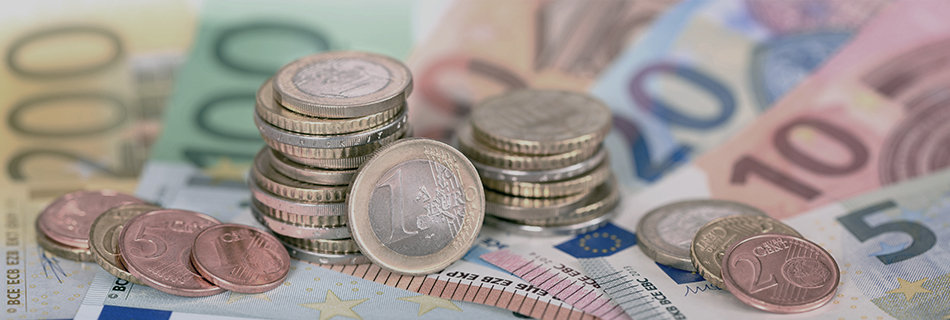
A few facts about the EUR
- The € symbol is based on the Greek letter epsilon (Є), a reference to the origins of European civilisation and the first letter of the word Europe. In turn, the two parallel lines emphasise the stability of the Union.
- The euro coins were designed by Luc Luycx. The reverse is common to all countries - it features a map of Europe. By contrast, each country includes its own national symbols on the front of the euro.
- The designer of the euro banknotes is Robert Kalina. The reverse also depicts a map of Europe and bridges from different eras, while the euro obverse shows other architectural elements: windows or gates, from the times corresponding to the bridges on the reverse.
- There are special editions of Euro Souvenir banknotes. Although they have security features similar to circulating banknotes, they only have collector value and cannot be used to make payments. They are issued in denominations of 0. Various EU countries issue commemorative banknotes, including those that have not yet adopted the euro as their currency, such as Poland.
FAQ – Frequently Asked Questions
Which countries currently belong to the eurozone?
The eurozone comprises 21 EU Member States: Austria, Belgium, Bulgaria, Croatia, Cyprus, Estonia, Finland, France, Greece, Spain, the Netherlands, Ireland, Lithuania, Luxembourg, Latvia, Malta, Germany, Portugal, Slovakia, Slovenia and Italy.
In which countries outside the eurozone can you pay in euros?
The euro is used as the official currency by the microstates of Andorra, Monaco, San Marino and the Vatican, as well as Montenegro and Kosovo. Furthermore, the currency is widely accepted in international trade and tourism, including at holiday resorts in Egypt, Turkey and Tunisia.
How does the eurozone differ from the European Union?
The European Union is a political and economic community of 27 countries. The eurozone is an area within the EU comprising 21 countries that have adopted the euro as their official currency, replacing their previous national currencies.
In which years did the various countries join the eurozone?
The following countries joined the eurozone in turn: 1999 – Austria, Belgium, Finland, France, Spain, the Netherlands, Ireland, Luxembourg, Germany, Portugal, Italy; 2001 – Greece; 2007 – Slovenia; 2008 – Cyprus, Malta; 2009 – Slovakia; 2011 – Estonia; 2014 – Latvia; 2015 – Lithuania; 2023 – Croatia; 2026 – Bulgaria.
What factors influence fluctuations in the euro exchange rate?
The exchange rate is influenced by the monetary policy of the European Central Bank (interest rates, money supply), economic indicators (inflation, GDP), the trade balance and the EU’s overall position in global politics and trade.
Which EU countries have committed to adopting the euro?
Poland, the Czech Republic, Hungary, Romania and Sweden have committed under the Treaty to introducing the euro once they have met the convergence criteria. Denmark has negotiated a legal opt-out clause, which exempts it from the obligation to adopt the single currency.
Why is the euro a global reserve currency?
This status stems from the euro area’s position within the global financial system and the EU’s significant role in global politics and trade. High confidence in European economies and price stability mean that central banks hold their reserves in euros.
Current euro exchange rate always at hand
Walutomat gives you the opportunity to buy or sell euro currency. You can make the exchange using your bank account or use the funds in your Wallet directly. The current euro exchange rate is available on the Walutomat website. You will also find a list of offers from users and information on the exchange rate in the past. You can check the data from the start of the website in 2009. To find out how much is euro currency, just look at the information given at the top of the site. It shows today’s euro exchange rate, but also the average euro exchange rate calculated on the basis of Forex data. All this information will make your decision to buy currency easier. Remember that the situation in the markets changes with lightning speed – you too can exchange at lightning speed with Walutomat.
Discount voucher for new customers!
Enter your email address and we will send you a 50% discount codea
for the commission on your first exchange.
Receive an e-mail!
We have sent you an email with a 50% discount code for the commission on your first exchange! Click on the link in the email and register to use the discount.